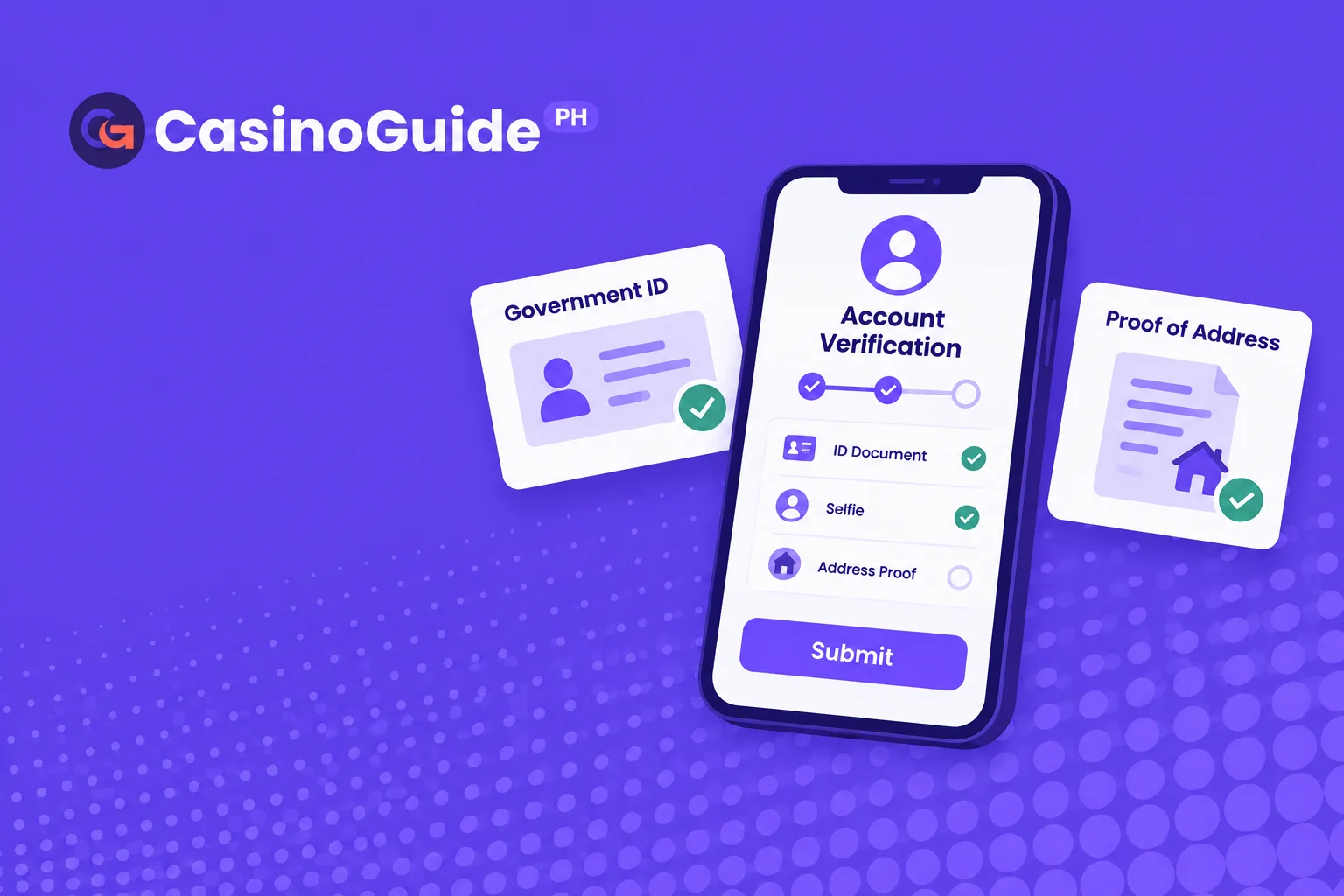
Account verification, often called KYC (“know your customer”), is the identity check licensed online casinos run before you can deposit or withdraw. It can feel like a hassle, but it is required by law and it protects you: it keeps minors out, stops other people from using your identity, and makes sure winnings go to the right person. This guide explains why casinos verify accounts, what they ask for, how KYC affects withdrawals and how to fix the most common problems.
- Casinos, including internet-based casinos, are covered persons under the Anti-Money Laundering Act, so identity checks are a legal requirement.
- In February 2026, PAGCOR said players must complete initial KYC, including a valid government ID and a real-time selfie with the ID, before they can deposit.
- Most withdrawal delays come from incomplete verification or a name mismatch between your casino account, ID and payment account.
- A casino will never need your passwords, PINs or one-time codes for verification.
Why online casinos verify your account
Anti-money laundering law. Republic Act No. 10927, signed on 14 July 2017, made casinos covered persons under the Anti-Money Laundering Act of 2001. The law explicitly includes internet-based casinos. Covered persons must know who their customers are, keep records and report certain transactions. RA 10927 also sets a covered-transaction threshold for casinos of a single casino cash transaction above ₱5,000,000.
Age and eligibility rules. PAGCOR’s rules bar persons under 21, government officials and employees, members of the AFP and PNP, and people on its exclusion lists from gambling. Verification is how operators enforce these rules.
Stopping identity misuse. In February 2026, PAGCOR said it was requiring initial KYC before registrants can deposit, to reduce the use of borrowed or fake identities. Read more about PAGCOR’s role in what PAGCOR means for online casino players.
What casinos ask for account verification
| Item | Why |
|---|---|
| Full name, birth date, address, contact details | To identify you and confirm your age |
| A valid government-issued photo ID | To prove your identity |
| A real-time selfie holding your ID | To show the ID belongs to the person using the account |
| Proof of your payment account (sometimes) | To confirm withdrawals go to an account in your name |
| Source of funds (rare, for large amounts) | Anti-money laundering checks |
Requirements vary by operator. Use only the upload page inside your account on the operator’s official site or app.
How KYC affects withdrawals
Most players first notice verification when they try to withdraw. Common reasons a payout is held:
- Verification not finished: the ID or selfie step is still pending or was rejected.
- Name mismatch: your casino account, ID and e-wallet or bank account show different names (including nicknames or missing middle names).
- Unclear documents: blurred photos, cropped corners, glare or an expired ID.
- A bonus still active: wagering not yet met, which is a bonus rule rather than KYC.
Our guides to how to withdraw online casino winnings and casino withdrawal times cover the full payout process.
Complete verification right after you register, before your first deposit, so nothing holds up your first withdrawal.
How to pass verification the first time
- Use your real, full name exactly as it appears on your ID.
- Use an ID that is valid and not expired.
- Take photos in good light, with all four corners visible and no glare.
- Take the selfie live when asked; do not upload an old photo.
- Use a payment account in your own name.
- Keep a note of when you submitted and any reference number.
KYC safety: protect your data
Verification involves sensitive documents, so only share them with an operator you have checked:
- Verify the operator and domain on PAGCOR’s records first. See how to tell if an online casino is legit.
- Upload documents only through the operator’s own site or app, never by chat, social media or email to an “agent”.
- Never share passwords, PINs or one-time codes. Verification never needs them.
- Be wary of anyone who asks for a fee to “speed up” verification or “unlock” a withdrawal. See online casino scams.
Verification problems and what to do
| Problem | What to do |
|---|---|
| Rejected ID photo | Retake in better light with all corners visible; check the ID isn’t expired |
| Selfie failed | Remove glasses or hats, face the camera directly, hold the ID beside your face as instructed |
| Name mismatch | Ask support how to correct your account name; use a payment account in the same name |
| Verification taking too long | Contact support in writing, quoting your submission date |
| Asked to send documents by chat or to pay a fee | Stop. This is a warning sign; contact the operator through its official site |
Our take
In our view, smooth verification is one of the best signs of a well-run licensed casino, and a site that lets you deposit without any checks is a red flag, especially since PAGCOR’s February 2026 statement on KYC before deposit. Verify early, keep your details consistent everywhere, and treat any request for codes or fees as a scam warning.
FAQ
What is KYC in an online casino?
KYC means “know your customer”. It is the process casinos use to confirm your identity and age, required under anti-money laundering law and PAGCOR rules.
Why do I need a selfie with my ID?
The selfie shows that the ID belongs to the person using the account. PAGCOR said in February 2026 that a real-time selfie with a valid government ID is part of initial KYC.
Can I deposit before I’m verified?
PAGCOR said in February 2026 that registrants must complete initial KYC before they can deposit. Some operators may also check again before withdrawals.
How long does casino verification take?
It depends on the operator and how clear your documents are. Submit good-quality documents early to avoid delays.
Is it safe to send my ID to an online casino?
Only to a PAGCOR-licensed operator, through its official site or app. Never send documents by chat or social media.
Play responsibly
Verification is also how exclusion rules are enforced. If you want to take a break from gambling, PAGCOR offers self-exclusion. For free, confidential support, call PAGCOR’s 24/7 National Problem Gambling Helpline at (02) 8248-9568, or read our responsible gambling guide.
This site is for 21+ only. Please gamble responsibly.
Sources
- Republic Act No. 10927 (casinos as covered persons under the AMLA), via Lawphil: lawphil.net
- AGBrief, “PAGCOR tightens regulations on online gambling“, 11 Feb 2026: agbrief.com
- PAGCOR, Responsible Gaming page (barred persons, helplines), accessed 9 Nov 2026: pagcor.ph
Last updated: 12 November 2026