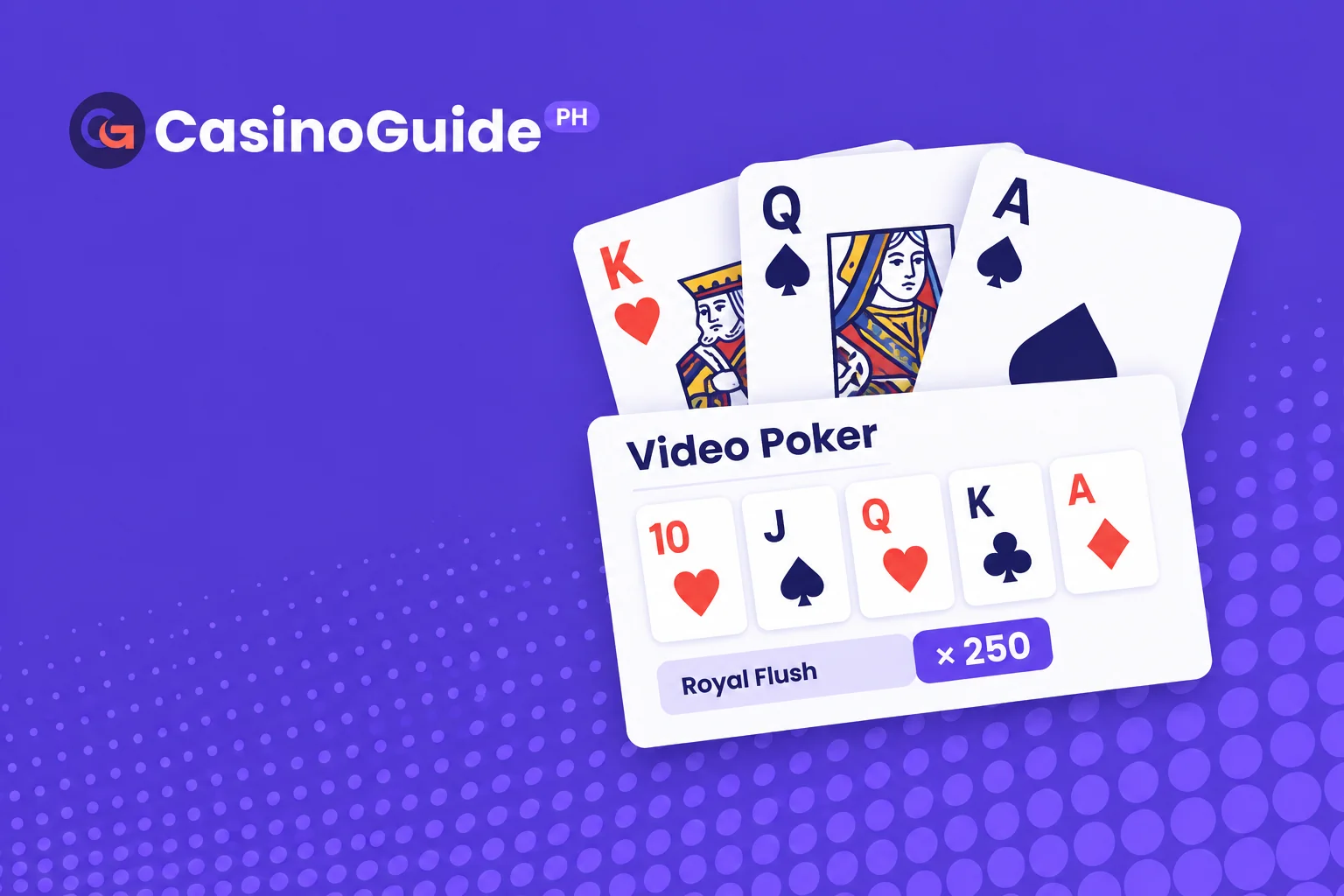
Video poker is a casino game based on five-card draw poker, played against a paytable rather than against other players or a dealer. You are dealt five cards, choose which to keep, draw replacements, and are paid according to the final hand. Unlike slots, your decisions change the result, and with the right paytable and correct play, video poker can have one of the lowest house edges in the casino. This guide explains the rules, why the paytable matters so much, and the mistakes that cost players most.
- You're paid by a fixed paytable; the better the paytable, the higher the return.
- Full-pay "9/6" Jacks or Better returns about 99.54% with perfect play. An "8/5" version returns about 97.30%.
- Your hold decisions matter: poor play can cost several percentage points.
- Check the paytable before you play, and play only at PAGCOR-licensed operators.
How a hand of video poker works
- Choose your bet, usually 1 to 5 coins per hand. Many paytables pay a bonus on a Royal Flush at 5 coins.
- Press Deal. You get five cards.
- Hold the cards you want to keep by tapping them.
- Press Draw. The cards you didn't hold are replaced.
- Get paid if your final hand is on the paytable.
The cards come from a single virtual 52-card deck, shuffled for every hand by a random number generator.
Jacks or Better: the basic game
Jacks or Better is the most common version. The lowest paying hand is a pair of Jacks or higher. Hands from strongest to weakest:
| Hand | Example |
|---|---|
| Royal Flush | A K Q J 10, same suit |
| Straight Flush | 5 6 7 8 9, same suit |
| Four of a Kind | 9 9 9 9 + any |
| Full House | Three of a kind + a pair |
| Flush | Any five cards of one suit |
| Straight | Five cards in sequence |
| Three of a Kind | 7 7 7 + two others |
| Two Pair | J J 4 4 + one |
| Jacks or Better | A pair of J, Q, K or A |
Why the paytable matters
Jacks or Better games are named by what they pay for a Full House and a Flush (per coin). A "9/6" game pays 9 for a Full House and 6 for a Flush. Small changes there make a big difference to the return:
| Paytable (Full House / Flush) | Return with optimal play | Expected cost on ₱10,000 of bets |
|---|---|---|
| 9/6 ("full pay") | 99.54% | about ₱46 |
| 8/5 | 97.30% | about ₱270 |
| 7/5 | 96.15% | about ₱385 |
| 6/5 | 95.00% | about ₱500 |
Returns as published by Casino.org (March 2026). These figures assume correct strategy and the maximum-coin Royal Flush bonus where it applies. Always look at the paytable on the game screen before you play.
Basic strategy tips for Jacks or Better
Correct play is about holding the cards with the best expected value, not "going for big hands". A few well-known rules:
- Keep a paying hand (Jacks or Better or better) in most cases.
- Hold a pair of Jacks or better rather than drawing to a weak straight or flush.
- Hold four to a flush over a low pair.
- Hold four to a Royal Flush even if it means breaking a made flush or straight.
- Don't keep a "kicker" (an extra high card) with a pair.
- With nothing, hold high cards (J, Q, K, A) rather than discarding everything.
Full strategy charts exist for each paytable. Even a simple chart closes most of the gap between casual play and the published return.
Other video poker versions
- Bonus Poker / Double Bonus: pay more for certain Four of a Kind hands, and usually less for Two Pair or Full House.
- Deuces Wild: all 2s are wild, so the paytable starts at Three of a Kind.
- Joker Poker: a Joker acts as a wild card.
Each has its own paytable and strategy. Don't use a Jacks or Better chart on these games.
Video poker vs other casino games
| Game and bet | House edge |
|---|---|
| 9/6 Jacks or Better (optimal play) | About 0.46% |
| Blackjack (basic strategy, good rules) | About 0.5% |
| Baccarat Banker | 1.06% |
| European roulette | 2.70% |
Compare more games in our table games online guide, and see our online poker guide for poker against other players.
Common video poker mistakes
- Playing whatever paytable is in front of you. Check for 9/6 before you start.
- Chasing Royal Flushes by throwing away paying hands.
- Holding kickers and other "gut feeling" holds.
- Playing too fast. Video poker is quick; more hands per hour means a higher hourly cost.
- Using the wrong strategy for a variant.
Where to play video poker in the Philippines
Video poker is less common than slots in Philippine online lobbies, and availability depends on the operator. If you find it, check the paytable and verify the operator first using our guide on how to tell if an online casino is legit. Many versions have a demo mode; see our free slots and demo mode guide.
Our take
In our view, video poker is one of the best-value games for players who like making decisions, but only on a good paytable and with correct play. A 9/6 game played well costs a fraction of what most slots do; an 8/5 or 6/5 game played casually costs several times more. Learn one game, check the paytable, and keep the pace slow.
FAQ
What is the best video poker game?
For most players, full-pay 9/6 Jacks or Better, which returns about 99.54% with optimal play.
Does strategy matter in video poker?
Yes. Your hold decisions change the result, and poor play can lower the return by several percentage points.
Is video poker better than slots?
On a good paytable with correct play, video poker usually has a much lower house edge than slots. Slots require no decisions; video poker rewards learning.
Should I always bet maximum coins?
Many paytables pay a bonus for a Royal Flush only at maximum coins. Choose a coin size that lets you bet the maximum within your budget, or accept a slightly lower return.
Play responsibly
Video poker is fast. Set a budget and a time limit before you play, and stop when you reach either one. For free, confidential support, call PAGCOR's 24/7 National Problem Gambling Helpline at (02) 8248-9568, or read our responsible gambling guide.
This site is for 21+ only. Please gamble responsibly.
Sources
- Casino.org, Jacks or Better strategy guide (returns for 9/6, 8/5, 7/5, 6/5), 14 Mar 2026: casino.org
- House edges for other games computed by CasinoGuide PH from standard rules.
Last updated: 16 November 2026